Pearson Edexcel · GCSE · Music
Course version: 1MU0 · Version from Sept 2016
Musical vocabulary - Dynamics and performance matters: A kind of…
Full specification wording
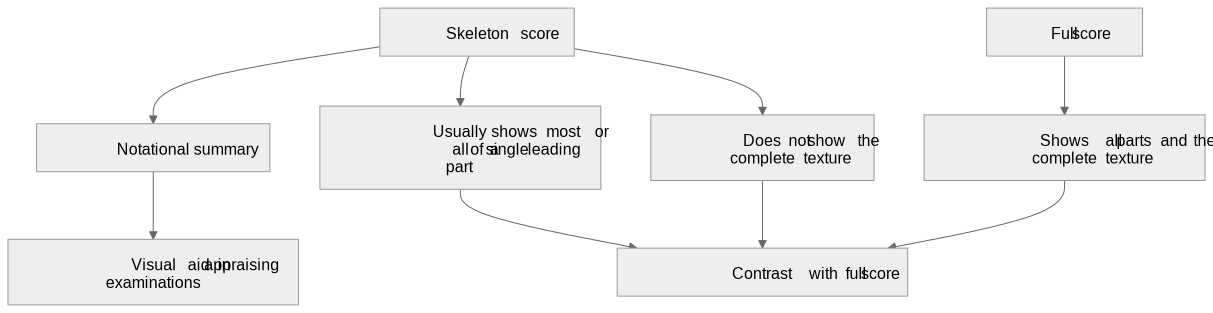
Appendix 3: Musical vocabulary - Dynamics and performance matters: A kind of notational summary – a visual aid for students in appraising examinations. It usually shows most or all of a single leading part rather than the complete texture
The term defined here is a skeleton score: a notational summary used as a visual aid in appraising examinations.
- Point 20 of 25
- 4 key terms
Study notes
From the teaching notes for this specification point.
The idea
The term defined here is a skeleton score: a notational summary used as a visual aid in appraising examinations. Rather than reproducing every strand of a piece, it typically presents most or all of one leading part, so the learner can follow the principal melodic line while listening. It is not a full score and does not show the complete texture. In practice, a skeleton score helps you track the leading part against a recording, note entries and phrasing, and relate what you hear to what is written. When a question asks you to identify this kind of reduced notational aid, the correct vocabulary term is skeleton score.
What earns the marks
- Identifies the term as skeleton score.
- Recognises that it is a notational summary acting as a visual aid in appraising examinations.
- States that it usually shows most or all of a single leading part.
- States that it does not show the complete texture.
Common mistakes and how to put them right
Confusing a skeleton score with a full orchestral score.
Put it right: A full score shows all parts and the complete texture, whereas a skeleton score reduces this to a leading part.
Assuming a skeleton score contains no notation at all.
Put it right: It is a notational summary, so it does contain written music, just not every part.
Treating the term as a listening-only aid with no notation.
Put it right: The definition stresses that it is notational, so link the term to written music.
Exam tips
- Learn the term alongside its function: a reduced notational aid for following a leading part during appraising.
- Contrast it explicitly with a full score so the distinction between one leading part and complete texture is clear.
- When a definition mentions a visual aid showing a single leading part, select skeleton score rather than a general score term.
Try the lesson
The start of the Appendix 3: Musical vocabulary - Dynamics and performance matters: A kind of notational summary – a visual aid for students in appraising examinations. It usually shows most or all of a single leading part rather than the complete texture lesson, made from teaching notes for this specification point.
Have a go first
Which statement best describes the typical content of a notational summary used as a visual aid in Edexcel GCSE Music appraising?
Listen
The term defined here is a skeleton score: a notational summary used as a visual aid in appraising examinations. Rather than reproducing every strand of a piece, it typically presents most or all of one leading part, so the learner can follow the principal melodic line while listening. It is not a full score and does not show the complete texture. In practice, a skeleton score helps you track the leading part against a recording, note entries and phrasing, and relate what you hear to what is written. When a question asks you to identify this kind of reduced notational aid, the correct vocabulary term is skeleton score. A strong answer earns marks for these points. Identifies the term as skeleton score. Recognises that it is a notational summary acting as a visual aid in appraising examinations. States that it usually shows most or all of a single leading part. States that it does not show the complete texture. Exam tip: Learn the term alongside its function: a reduced notational aid for following a leading part during appraising.
See it
Key words
Say what each word means before you turn the card.
Skeleton score
Try answering aloud or in your head before turning the card.
Appraising
Try answering aloud or in your head before turning the card.
Leading part
Try answering aloud or in your head before turning the card.
Complete texture
Try answering aloud or in your head before turning the card.
See every definition
- Skeleton score
- A notational summary that acts as a visual aid for students in appraising examinations.
- Appraising
- The examination context in which a skeleton score is used as a visual aid.
- Leading part
- What a skeleton score usually shows most or all of, rather than the complete texture.
- Complete texture
- What a skeleton score does not show, since it presents a single leading part instead.
Label the diagram
Some boxes have lost their names. Pick the right name for each number.
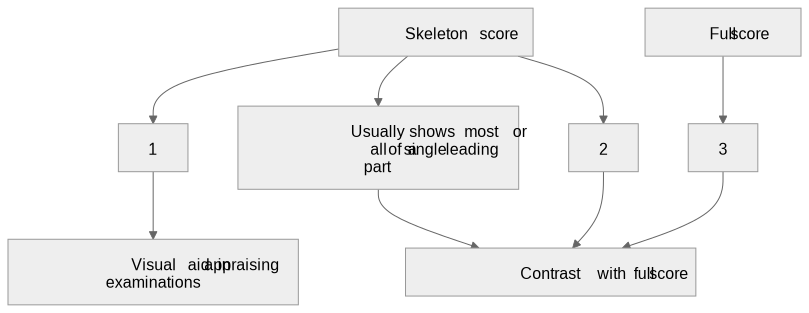
1Box 1
2Box 2
3Box 3
There is more to this lesson
The full lesson goes on to check your understanding and help you earn the marks. Create a free account to carry on, with your progress saved.
A week of Premium from your first lesson · Then the free plan continues · No card, no charge
Test your understanding of Appendix 3: Musical vocabulary - Dynamics and performance matters: A kind of notational summary – a visual aid for students in appraising examinations. It usually shows most or all of a single leading part rather than the complete texture
Active recall beats re-reading. Take an instant quiz now to test what you’ve learned and lock it into long-term memory.
A week of Premium from your first lesson · Then the free plan continues · No card, no charge